

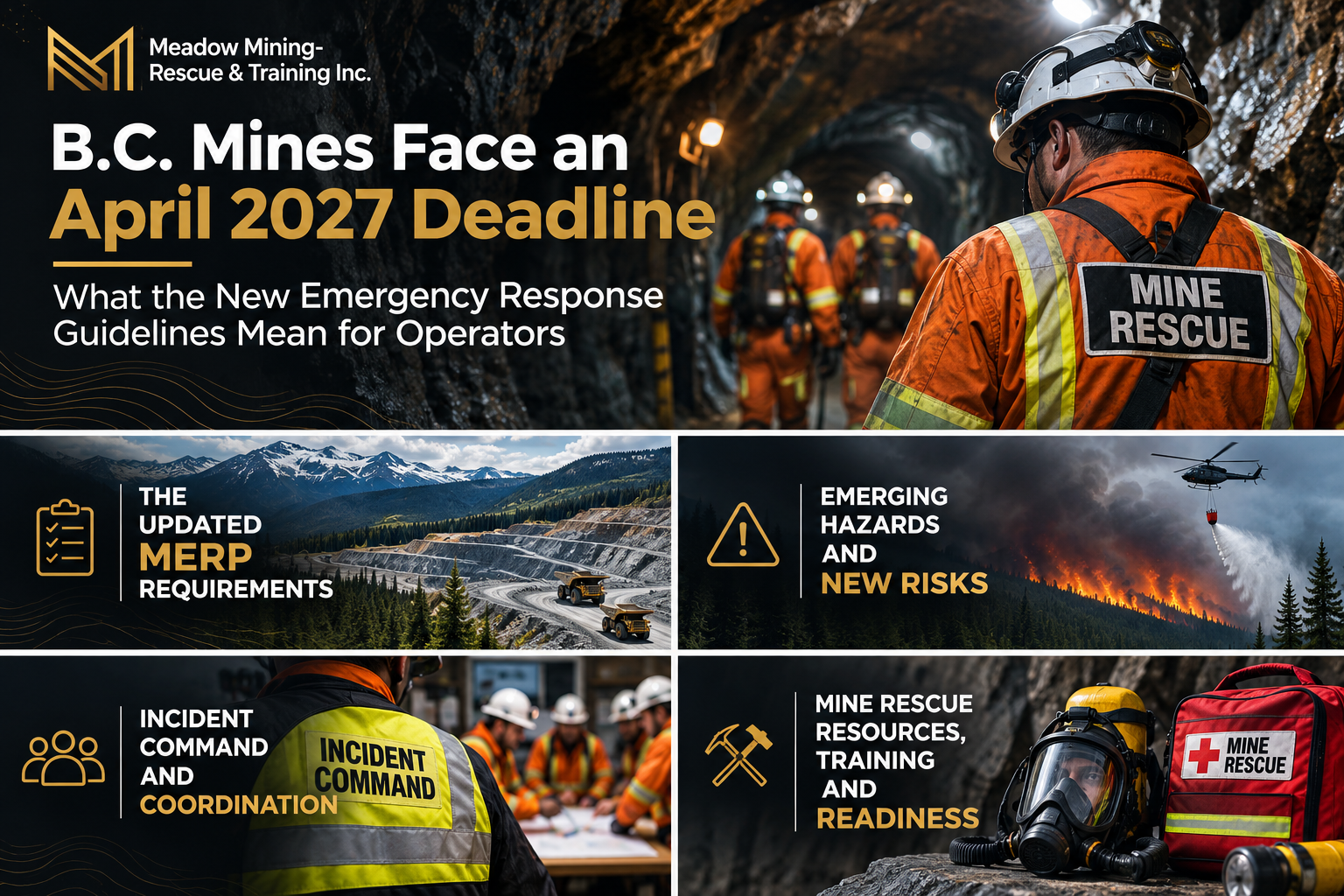
British Columbia has updated its Mine Emergency Response Plan requirements, and mining operations have until April 1, 2027, to align their plans with the revised provincial guidelines.
For mine managers, HSE leaders and emergency response coordinators, the changes introduce important considerations involving emergency planning, emerging hazards, incident command, mine rescue capabilities and workforce training.
The question is no longer simply whether an operation has an emergency response plan. It is whether that plan accurately reflects the risks, resources and personnel responsible for carrying it out.
With more than three decades of frontline mining and mine rescue experience behind its leadership, Meadow Mining-Rescue & Training Inc. works with mining operations to strengthen the systems, equipment, training and operational capabilities that support effective emergency response.
The revised requirements create an important opportunity for operators to evaluate those capabilities before the compliance deadline.
What Has Changed in B.C.'s Mine Emergency Response Requirements?
On February 18, 2026, the Office of the Chief Inspector of Mines issued updated Mine Emergency Response Plan Guidelines for the Mining Industry, replacing the previous 2017 version.
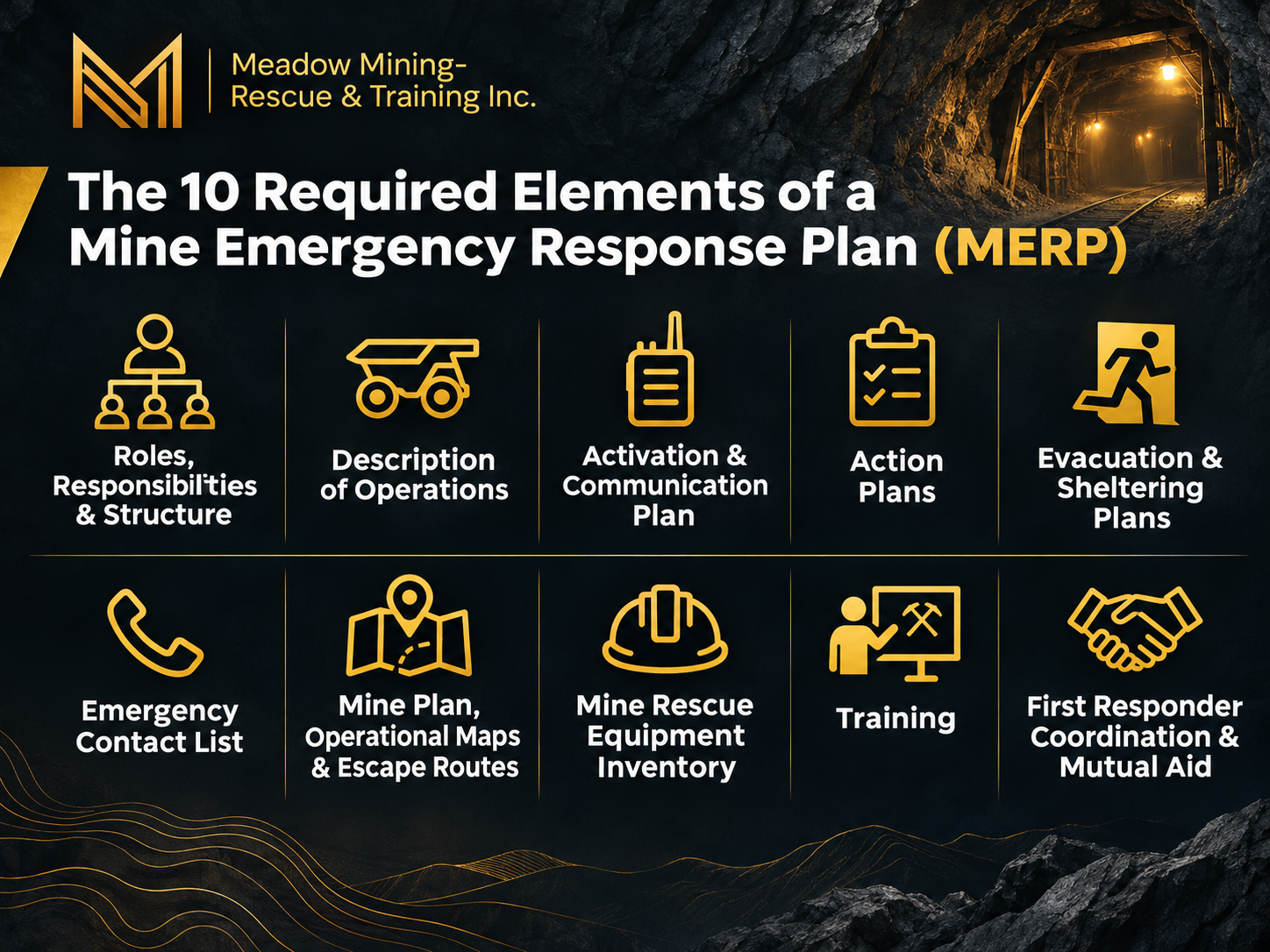
One of the most significant changes is the consolidation of 23 required Mine Emergency Response Plan (MERP) elements into 10 clearly defined elements.
The new framework addresses:
Roles, Responsibilities & Structure
Description of Operations
Activation & Communication Plan
Action Plans
Evacuation & Sheltering Plans
Emergency Contact List
Mine Plan, Operational Maps & Escape Routes
Mine Rescue Equipment Inventory
Training
First Responder Coordination & Mutual Aid
The reduction in required elements is intended to provide a clearer, more effective framework—not diminish emergency preparedness responsibilities.
The revised guidelines also reflect evolving emergency management practices, climate-related hazards, technological developments and a greater emphasis on coordinated response.
All B.C. mines must have their MERPs reflect the updated required elements by April 1, 2027.
Operators can review the complete requirements in the 2026 B.C. Mine Emergency Response Plan Guidelines.
Emergency Planning Must Reflect the Operation, Not Just the Regulations
Every mining operation presents different challenges.
An underground mine, surface operation, remote exploration project or developing mine site may require substantially different emergency procedures, resources and response capabilities.
That distinction is central to the updated guidelines.
The province emphasizes a site-specific approach, supported by a Hazard, Risk and Vulnerability Analysis (HRVA). This process identifies potential hazards, assesses their risks and examines the vulnerabilities that could affect the consequences of an emergency.
For operators, this means considering not only what could happen, but also whether existing systems and resources are capable of managing the resulting conditions.
A response plan must reflect actual operating conditions, including personnel levels, equipment, access routes, communications, available rescue resources and external support arrangements.
Through Meadow Safety, mining organizations can access HSE advisory services, hazard identification and risk assessments, safety system development and operational support tailored to their environments.
Combined with the emergency management capabilities of Meadow Rescue, these services help organizations establish a stronger connection between risk identification, emergency planning and practical implementation.
New Hazards Are Changing the Emergency Response Environment
Mining emergency preparedness is no longer limited to the traditional hazards associated with underground and surface operations.
The 2026 guidelines specifically address emerging risks involving climate-related events, battery-electric mining equipment and cybersecurity threats.
Wildfires, flooding, severe weather and landslides can affect site access, workforce availability and evacuation procedures.
New equipment technologies may introduce hazards requiring specialized response procedures, training or equipment.
Cybersecurity incidents may affect operational systems, communications or the resources needed to coordinate a response.
These developments reinforce the importance of examining emergency preparedness as an integrated operational system.
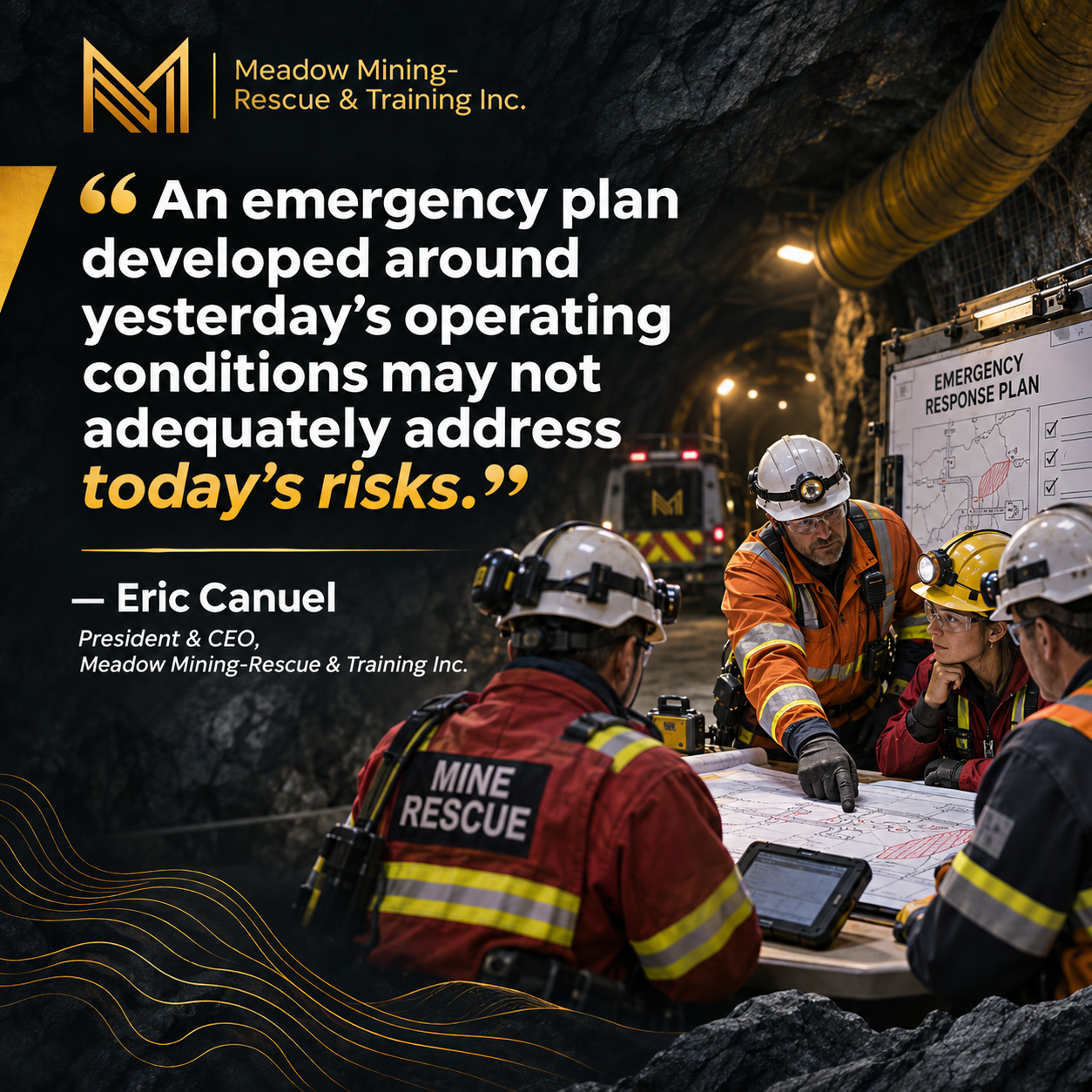
An emergency plan developed around yesterday's operating conditions may not adequately address today's risks.
Meadow's safety consulting services support organizations through safety system analysis, emergency program design, documentation and practical implementation.
For mine operators reviewing their MERPs, that process provides an opportunity to examine how emerging hazards influence emergency procedures, personnel responsibilities and the resources required to respond.
Incident Command: Knowing Who Takes Control When an Emergency Escalates
One of the important features of the revised guidelines is the expanded emphasis on the Incident Command System (ICS).
The updated framework introduces three emergency levels and provides additional guidance on incident command structures and Emergency Operations Centres.
The purpose is to establish clear responsibilities, effective communication and appropriate coordination as an incident develops.
An emergency that can be managed by on-site personnel requires a different level of coordination than an incident involving multiple responding agencies, specialized rescue resources or widespread operational disruption.
For mine management, the important questions include whether emergency leadership responsibilities are clearly established, whether the appropriate personnel understand their roles and whether communication arrangements will function effectively under pressure.
These are operational considerations, not simply documentation requirements.
Meadow Rescue provides emergency management advisory services that include emergency response system development, incident command system implementation, response planning and operational coordination.
Led by Eric Canuel, whose experience encompasses more than 30 years in mine rescue, Meadow brings an operational perspective to the development of emergency command structures.
Establishing a system is one component of readiness. Ensuring personnel understand how to operate within it is another.

Evacuation and Sheltering: Planning for When the Unexpected Happens
Remote mining environments present unique emergency challenges.
Access roads may become unavailable. Severe weather may interrupt transportation. Wildfires may threaten evacuation routes, while certain emergency conditions may require personnel to shelter on site rather than leave.
The revised guidelines place clearer emphasis on evacuation procedures, operational mapping, escape routes and shelter-in-place planning.
An effective MERP must address the site's specific conditions, including how personnel will be notified, where they will assemble, how they will evacuate and what alternatives exist when normal procedures cannot be followed.
For operations with rotating workforces, contractors and multiple crews, these procedures must also be understood by personnel who may not be familiar with every aspect of the site.
This is where planning and training must function together.
Through Meadow Training, organizations can access emergency response training, incident command instruction, safety leadership development and customized programs designed around site-specific requirements.
Training helps bridge the gap between established procedures and the actions personnel are expected to take during an actual emergency.
Mine Rescue Equipment and Response Capabilities Under Review
The updated MERP framework includes a dedicated element addressing mine rescue equipment inventories.
Operators must maintain an inventory of available emergency response equipment, including relevant resources and their locations.
For mine rescue teams, equipment readiness extends beyond maintaining a list.
Equipment selection, maintenance, operating knowledge, personnel competency and the ability to deploy resources effectively are all practical considerations in emergency preparedness.
Different mining environments require different capabilities.
Underground rescue operations may involve breathing apparatus, hazardous atmospheres, restricted access and specialized rescue techniques. Surface operations present their own response challenges depending on site conditions and identified risks.
Through its Mine Rescue services, Meadow supports mine rescue program implementation, rescue equipment procurement, technical equipment training and operational readiness.
The company also provides Dräger technical training and works with operations to align rescue equipment and personnel capabilities with their specific requirements.
The objective is to ensure that the equipment identified within an emergency response system is supported by the knowledge, training and procedures necessary for effective deployment.
Mutual Aid and First Responder Coordination
Not every emergency can be managed using a mine's internal resources alone.
The revised guidelines recognize the importance of planning for incidents that could exceed an operation's available response capabilities.
Depending on the location, size and complexity of a mine, these arrangements may include mutual aid agreements with neighbouring operations, fee-for-service contracts or documented coordination with local emergency responders.
For remote operations, this requires careful consideration.
Distance, weather, transportation, equipment availability and the capabilities of outside agencies can all influence response arrangements.
Importantly, mutual aid does not replace the mine rescue capabilities required under provincial regulations. External resources are intended to complement an operation's own preparedness.
Meadow Rescue's emergency management advisory services include response coordination, emergency management systems and the development of procedures supporting effective incident management.
With experience across mining operations and emergency response environments, Meadow can assist organizations in reviewing how their internal capabilities, coordination arrangements and emergency management structures fit together.
Training and Testing: Where Emergency Plans Become Operational Readiness
An emergency response plan is only one component of an effective emergency management program.
Personnel must understand the plan, know their responsibilities and be prepared to execute established procedures when required.
British Columbia's mining Code requires annual testing of MERP effectiveness, including the involvement of potentially impacted First Nations in testing.
The 2026 guidelines reinforce the importance of practical training, exercises, communication and continuous improvement.
An emergency exercise can reveal issues that may not be apparent during a document review.
Communication procedures may require refinement. Equipment deployment may identify training needs. Coordination between departments or responding agencies may expose opportunities for improvement.
These findings allow mine management to strengthen preparedness before a real emergency occurs.
Meadow Training delivers competency-based mine rescue, emergency response and incident command training, including programs tailored to individual operations.
The training division is supported by Ministry-approved mine rescue examiners and instructors with practical industry experience.
For organizations reviewing their emergency programs, training and exercises provide a way to assess whether personnel can translate emergency procedures into coordinated action.
The effectiveness of a response plan depends on the preparedness of the people expected to execute it.
What Should Mine Operators Be Reviewing Before April 1, 2027?
The revised guidelines provide an opportunity to examine emergency preparedness across several interconnected areas.
Mine managers and HSE leadership should consider whether their existing MERPs incorporate all 10 required elements and accurately reflect current operating conditions.
Hazard assessments should account for relevant emerging risks, while emergency leadership responsibilities and incident command procedures should be clearly established.
Emergency communications, evacuation arrangements, operational maps and sheltering procedures should reflect the site's present configuration.
Mine rescue equipment inventories should be current, and personnel must have the training necessary to perform their assigned responsibilities.
Operators should also evaluate arrangements for outside assistance, coordination with potentially affected communities and First Nations, and the effectiveness of their training and testing programs.
These considerations involve multiple areas of mine management.
That is one of the advantages of working with an organization whose expertise extends beyond a single aspect of emergency response.
Meadow Mining-Rescue & Training Inc. brings together four complementary divisions—Mining, Safety, Rescue and Training—to support operational leadership, safety systems, rescue capabilities and workforce competency.
Rather than approaching emergency preparedness as an isolated activity, Meadow works to connect the people, systems and practical resources that support operational readiness.
Explore Meadow's services and operational capabilities.
Experience Matters When Preparedness Meets Reality
The updated B.C. guidelines represent an important development in mine emergency management, but the principles behind effective preparedness remain grounded in operational experience.
Emergency plans must be practical. Responsibilities must be understood. Equipment must be appropriate and available. Personnel must be capable of carrying out their assigned roles.
For Eric Canuel, President and CEO of Meadow Mining-Rescue & Training Inc., those considerations are informed by more than three decades working in underground and surface mining, mine rescue and emergency response.
Learn more about Eric Canuel and Meadow's background.
That experience informs Meadow's approach to supporting mine operators through emergency management advisory services, rescue program development, HSE systems and specialized training.
As the April 1, 2027 compliance deadline approaches, mining companies have an opportunity to evaluate not only their documentation but also the operational readiness behind it.
The updated guidelines provide the framework.
The responsibility for developing and maintaining an effective emergency response system remains with each mine.
Because when an emergency occurs, preparedness is measured by the response—not simply by the plan.
Preparing for the April 2027 Deadline?
Whether your operation requires assistance reviewing emergency management systems, developing mine rescue capabilities, strengthening HSE procedures or delivering specialized rescue and incident command training, Meadow can provide support tailored to your operational requirements.
Connect with Meadow Mining-Rescue & Training Inc. to discuss your emergency preparedness needs.
Explore Meadow Rescue and Emergency Management Services